
-
Read the full report in German
Full report (DE) -
Read the full report in French
Full report (FR)
State reporting procedures in relation to Switzerland
Published: 07.05.2024 / Updated: 20.04.2026
In Switzerland human rights are protected primarily through the fundamental rights enshrined in national legislation. International human rights treaties provide additional safeguards and stimulus. Regular monitoring of the implementation of these treaties takes place through state reporting procedures. The SHRI commissioned a survey of these procedures in relation to Switzerland.
The information here is based on materials produced by research consultancy Interface Politikstudien Forschung Beratung AG (Interface) and interpreted by the SHRI.
Switzerland has ratified a number of major UN human rights treaties, including the Convention on the Elimination of all Forms of Discrimination Against Women (CEDAW), the Convention on the Rights of the Child (CRC) and the Convention on the Elimination of all Forms of Racial Discrimination (CERD). The Council of Europe also provides a legal basis for the protection of human rights, most importantly through the European Convention on Human Rights. Switzerland has ratified several other conventions of the Council of Europe, including on the prevention of torture, trafficking in human beings and domestic violence. The implementation of these international treaties is monitored regularly through what are known as state reporting procedures.
The SHRI commissioned Interface to conduct a study of Switzerland’s state reporting procedures. The main aims of the study were to determine the state of implementation of human rights protections in Switzerland and to gather information about the reporting procedures.
At the end of the study two mapping documents and a report were produced. The first mapping document contains information about how the state reporting procedures are conducted. The intention was to provide an overview of the processes, responsibilities and timescales involved for the different procedures. The second mapping document contains all the recommendations issued to Switzerland by international bodies during the current monitoring cycles. Interface then produced a synthesis report with the key findings from the two mapping exercises and provided some recommendations.
-
Report by Interface
About the state reporting procedures
State reporting procedures are mechanisms established for monitoring the implementation of international human rights treaties. For many of the treaties, an initial review is undertaken one or two years following ratification. After this, states parties are usually reviewed at regular intervals (roughly every 4-5 years).
Who is involved in state reporting procedures?
In addition to the UN or Council of Europe bodies, the key stakeholders in Switzerland’s state reporting procedures are the relevant federal agencies. Most state reporting procedures are managed by a single federal agency and relate to a specific treaty. For example, the Federal Office for Gender Equality is responsible for reporting on the Istanbul Convention. However, at the UN level there is also a general procedure which is not confined to a specific convention. This is known as the Universal Periodic Review (UPR). Because it covers a wide range of topics, a number of federal agencies are involved in this review process.
The cantons and municipalities also play an important role. Switzerland’s federal system of government means that responsibility for implementing measures to protect human rights largely lies with these entities. For example, the cantons are responsible for awareness-raising in the police force, providing prisons with resources and ensuring schools are more inclusive.
Civil society organisations have a role in the state reporting procedures as critical observers. They provide the international bodies with information that is independent of the state, in the form of alternative reports.
How state reporting procedures work
State reporting procedures can be subdivided into four processes. The federal agency managing the procedure is responsible for the smooth running of these processes:
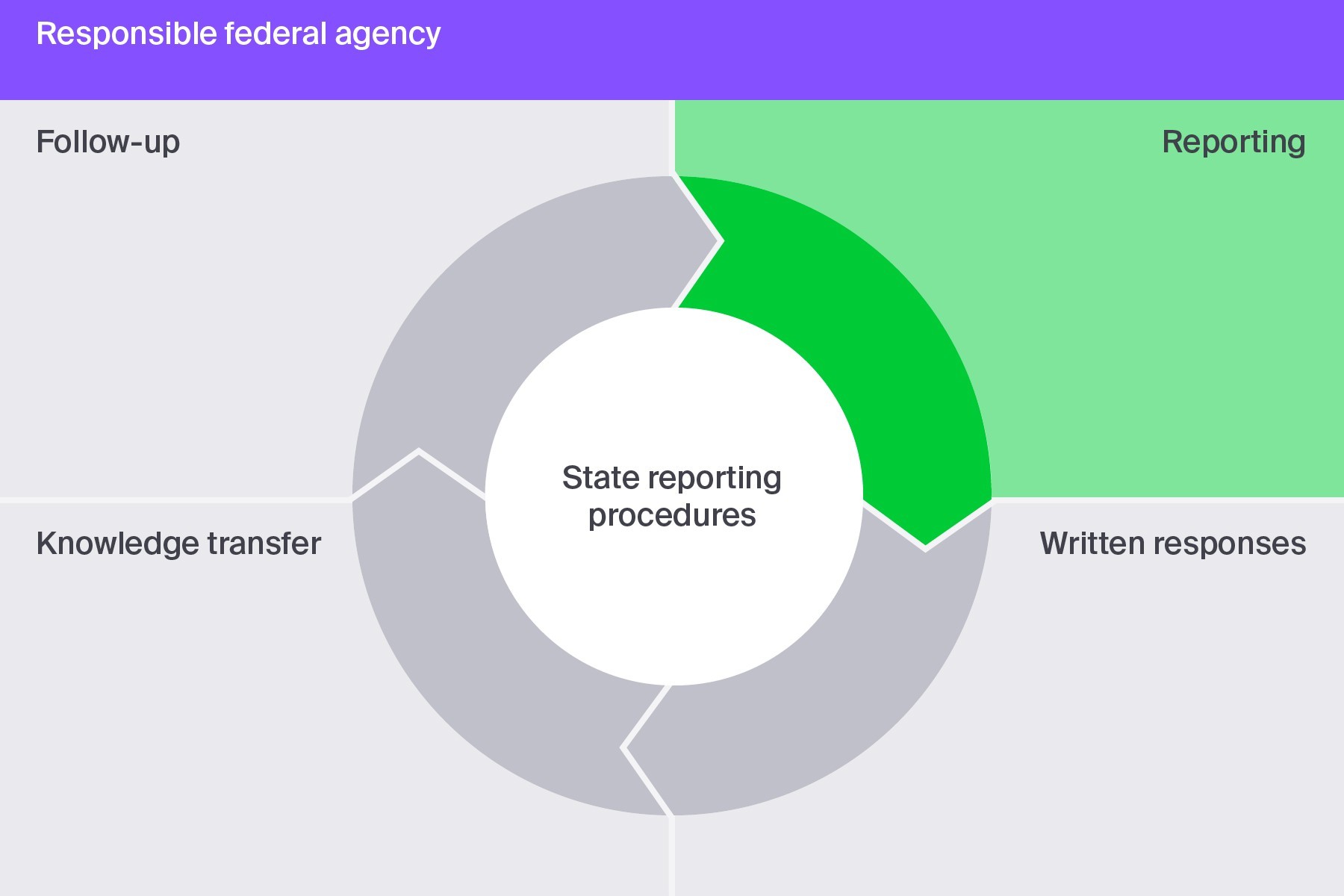
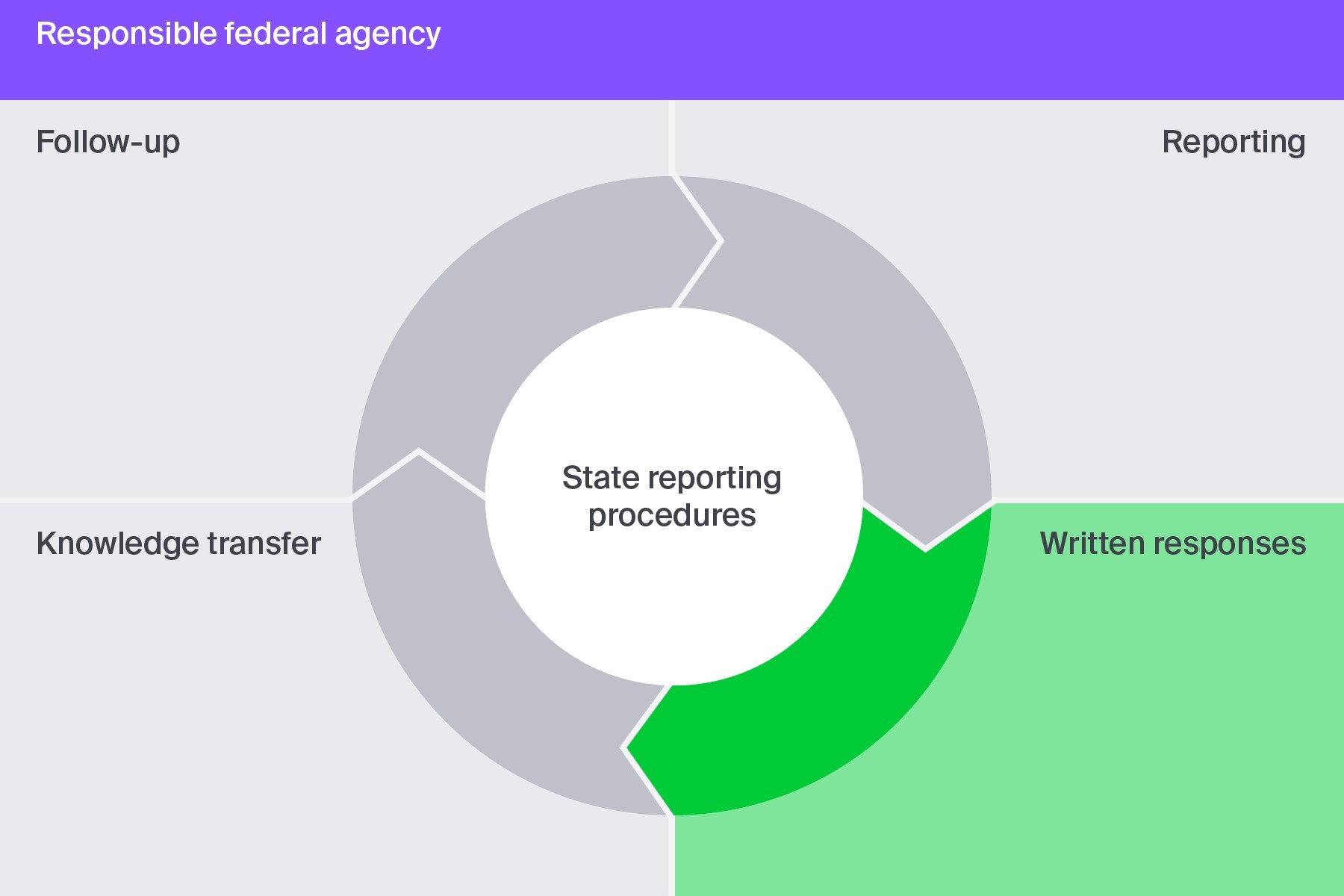
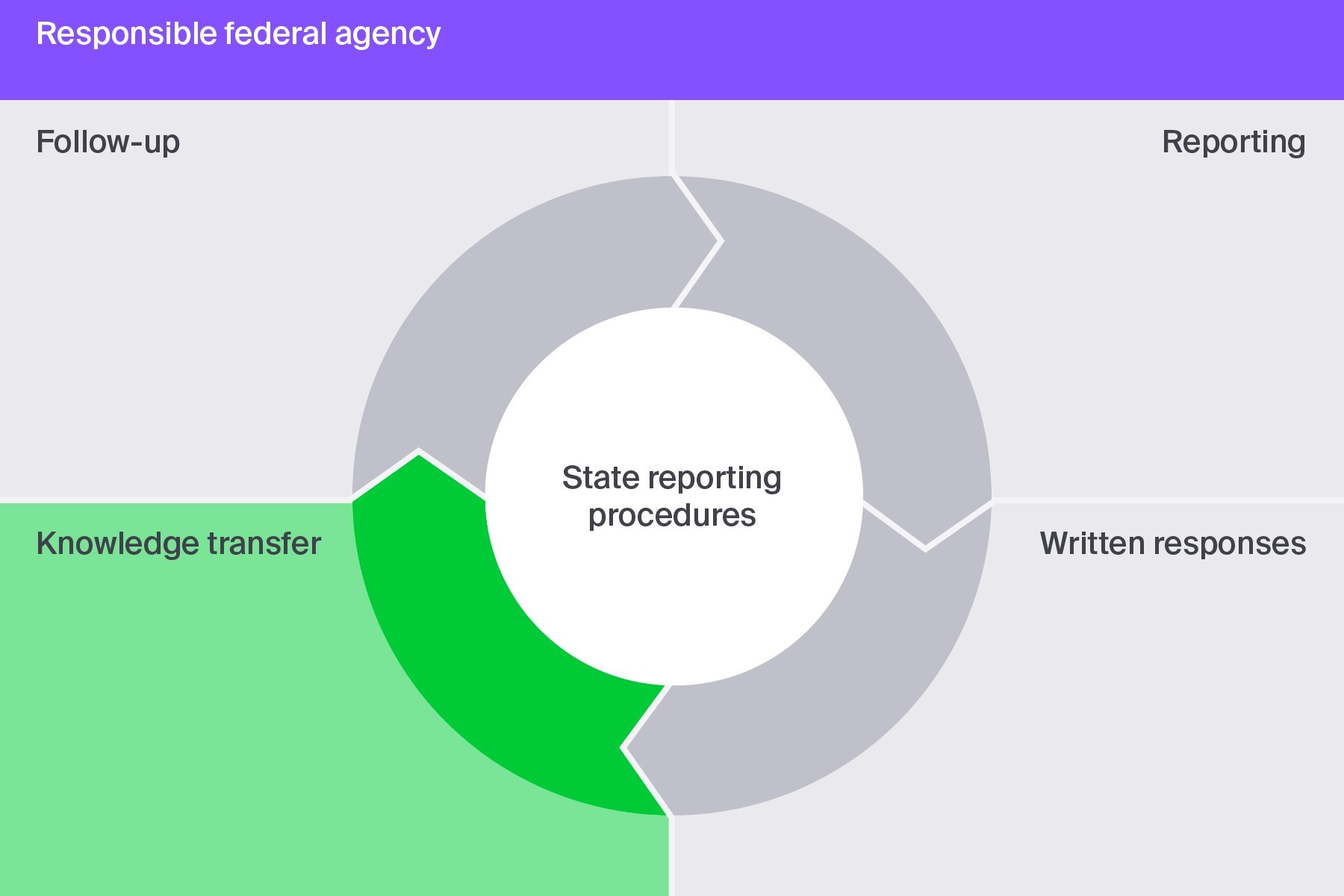
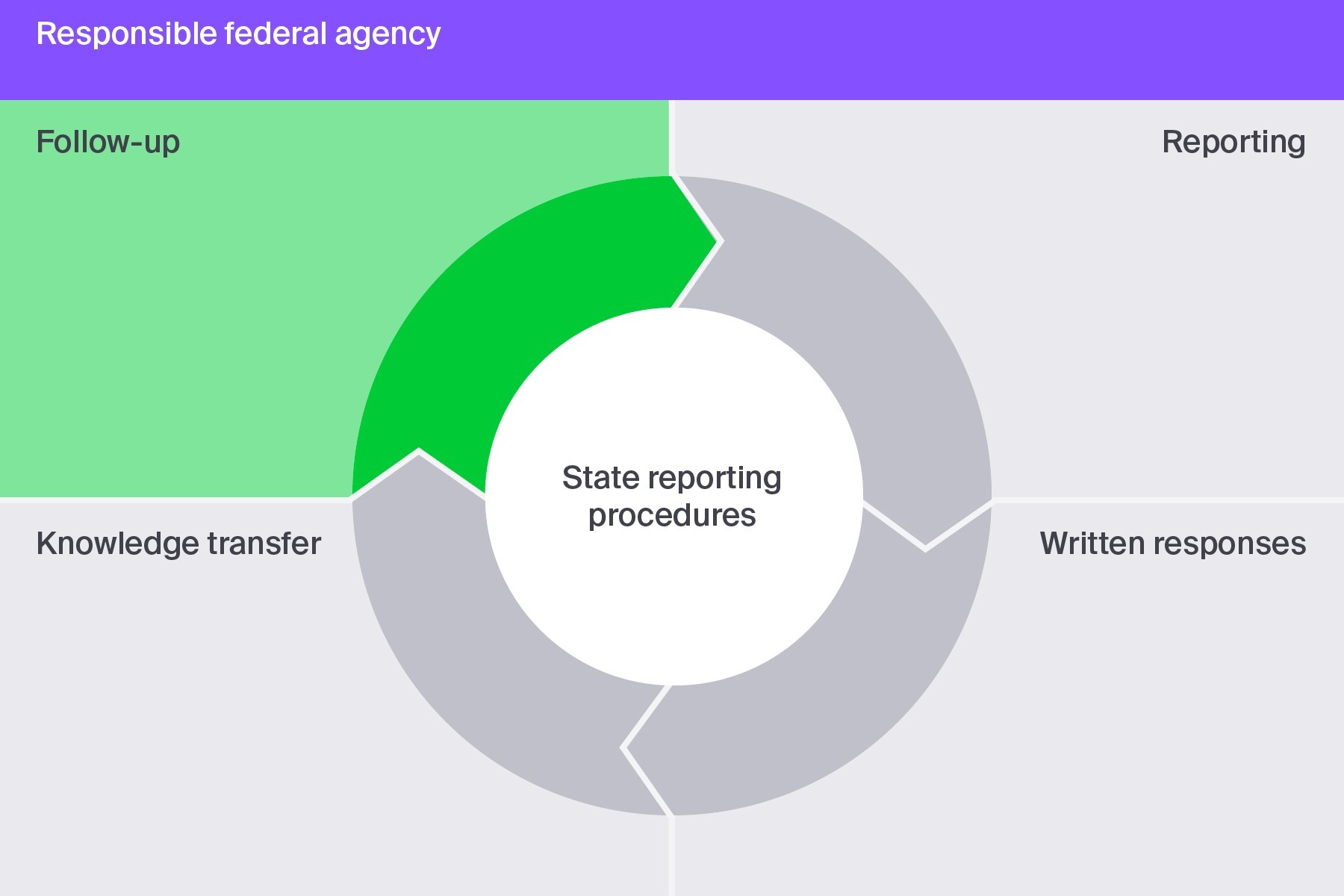
Reporting: The reporting process involves the preparation and submission of the state report, as well as alternative reports produced by civil society organisations. These reports are examined by the relevant international body which then produces a list of issues, identifying shortcomings in relation to the human rights protections provided for in the treaty. It gives recommendations for how these issues may be resolved.
Written responses: In many cases the state party may provide written responses to the list of issues produced by the international body. These statements include comments in response to the observations and recommendations received, outline any challenges identified and set out the proposed way forward.
Knowledge transfer: Next the knowledge acquired through the communication process with the bodies must be shared with the relevant stakeholders. These include, in particular, the state entities at national, cantonal or municipal level with specific responsibility for implementing the recommended action.
Follow-up: Action to improve the human rights situation is taken, reviewed and the implementation again evaluated by the relevant treaty body. In some cases follow-up actions may be required.
Implementing the recommendations from the state reporting procedures
State reporting procedures are only effective if they lead to action being taken and subsequently to better protection for human rights. However, in the study it conducted for the SHRI, Interface identified a number of factors which can hinder these processes and which are particularly relevant for Switzerland. In summary:
In Switzerland’s federal system, the federal government is limited in the extent to which it can impose measures on the cantons. This represents a challenge for the consistent implementation of the recommendations.
Referendums can prevent measures from being implemented or may even go directly against human rights standards. This is further compounded by the already lengthy processes for ratifying new human rights protection laws.
The large number of stakeholders hinders the coordination of the reporting process and the implementation of the recommended actions. In addition, there is currently no overarching monitoring system for the implementation of the actions.
According to Interface, a number of actions could be taken to make the protection of human rights in Switzerland more effective. In summary:
Provided there is the political will, the content of the treaties could be incorporated more definitively and comprehensively by democratic means into national and cantonal law.
The protection of human rights could be enhanced by clearly defining who is responsible for what in implementing the measures to be taken. Nationwide monitoring of this implementation could be helpful.
By addressing human rights issues in society, policymaking and the justice system, a human rights culture could be established which would have a positive impact on the protection of human rights.
Coming soon on our information portal: Detailed information on the state reporting procedures
The role of the SHRI
According to its legally defined mandate, the SHRI can act to promote and protect human rights in various ways. In relation to the state reporting procedures, in particular, the SHRI could play an important supporting role in the future.
This view is shared by Interface which provided the SHRI with a number of recommendations to guide its work in the future. These recommendations can be found after page 39 of the synthesis report DE (pdf) or page 41 of the synthesis report FR (pdf).
Interface’s recommendations to the SHRI are helpful, providing a useful decision-making tool for the development and focus of the SHRI’s work. Based on these recommendations, the SHRI established four thematic priorities for the next few years:
Democracy and human rights
Federalism and human rights
Outsourcing responsibility for human rights
Multiple discrimination
All these topics also touch on important aspects of Switzerland’s state reporting procedures.
Human rights mapping by Interface
The mapping exercises conducted by Interface involve compilations of large amounts of data relating to Switzerland’s state reporting procedures. Due to their complexity, they are primarily of use for in-depth research by experts and other interested parties.
Mapping results 1: Conducting state reporting procedures (Durchführung)
This mapping document provides an overview of the process for 16 state reporting procedures in Switzerland (9 UN and 7 Council of Europe).
The mapping results document is available in German, entitled ‘Durchführung’. The first sheet provides tips for users (‘Lesehilfe’). The second sheet (‘Mapping’) contains the data collected during the study. The information is based on the most recent reporting cycles (as at February 2024).
The mapping document contains general information, classified by international treaty, about which body is responsible for monitoring the implementation of each treaty, how frequently reviews are conducted, the legal basis for the review process and how the procedure usually works.
In addition, the mapping document contains specific information about Switzerland. This includes documents from the most recent or current monitoring cycle, information about when the most recent review was conducted, which federal agency managed the process and its precise mandate. There is also information showing who was responsible during the most recent reporting cycle for the coordinated preparation and submission of the alternative reports from civil society.
Mapping results 2: Recommendations for Switzerland (Empfehlungen)
Das Mapping enthält eine Übersicht über die Empfehlungen aus den letzten Überprüfungszyklen von 16 Staatenberichtsverfahren der Schweiz (9 auf UNO-Ebene, 7 auf Europaratsebene).
This mapping document provides an overview of the recommendations from the most recent monitoring cycles for 16 state reporting procedures undertaken in Switzerland (9 UN and 7 Council of Europe).
The recommendations are drawn from the concluding observations and recommendations produced by the monitoring bodies for the current monitoring cycles of the state reporting procedures (as at October 2023). The starting point for the document are the recommendations from the fourth round of the Universal Periodic Review (UPR) in 2023.
The recommendations resulting from the different monitoring procedures are organised by human rights theme (vertically) and by treaty (horizontally). The themes are listed in the tips for users, e.g. ‘Climate’. To find the recommendations for a specific theme, filters can be applied to the ‘Theme Category’ column. For instance, it can be set to display only the recommendations that relate to the theme of ‘Climate’. The mapping document includes a large amount of data and so there are other keywords that can be used to filter the results further. More details are provided in the tips for users.
-
Mapping documents by Interface
-
See mapping results 1 in German
Mapping results 1: Conducting state reporting procedures (DE) -
See mapping results 2 in German and English
Mapping results 2: Recommendations for Switzerland (DE and EN)
-